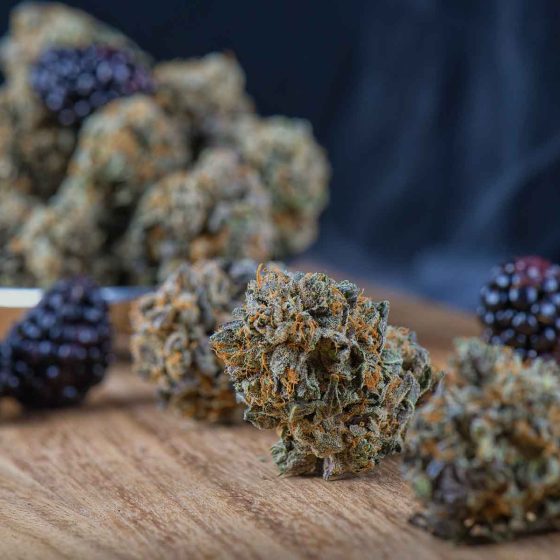
A bag of flower can look like cannabis, smell like cannabis, arrive in professional packaging with a familiar strain name and appear identical to what a consumer expects to buy.
But what if the effect does not come from the plant itself?
Across Europe, low-THC cannabis and CBD flower is being used as a carrier for synthetic and semi-synthetic cannabinoids. Some products are openly sold as infused or enhanced. Others may be presented as “weed”, “THC flower” or stronger hemp without any meaningful explanation of what has actually been added.
A consumer should know what is in the product they are smoking. If a laboratory-made cannabinoid has been sprayed onto flower, the customer should not have to discover that only after consuming it.
The European Union Drugs Agency (EUDA) now warns about the increasing adulteration of low-THC cannabis and CBD products with synthetic cannabinoids. It has documented these substances in herbal material that can appear to consumers to be ordinary hemp or cannabis.
For responsible CBD businesses, this is not somebody else’s problem. Every sprayed or mislabelled product risks damaging trust in the wider sector. That is why, at Originals CBD, we believe the issue needs to be discussed openly.
It looks like cannabis, and that is part of the problem
Low-THC cannabis flower makes an effective carrier for added cannabinoids because it already looks, smells and burns like cannabis.
Apply another cannabinoid after harvest, and there may be no obvious visual clue that anything has changed. EUDA reports that adulterated low-THC cannabis can resemble natural cannabis and, since 2020, at least 13 European countries have reported synthetic cannabinoids appearing alongside natural cannabinoids in herbal material consistent with low-THC hemp.
Two flowers could look almost identical. One may contain its naturally occurring cannabinoid profile. The other may have been treated with a highly potent synthetic cannabinoid. Looking won’t reveal the difference. Neither will smelling. Even experienced cannabis consumers may not realise what they have until after use.
By then, the decision has already been made for them.
What does “sprayed flower” actually mean?
The phrase is used loosely. What matters is the process. Has an active substance been added after harvest, was the consumer told, is the concentration known and was the resulting batch properly tested?
Synthetic cannabinoid receptor agonists, the broad family associated with products historically sold as “Spice”, are laboratory-made chemicals that act on cannabinoid receptors. Some are extremely potent and can cause profound effects at very small doses.
They are not the same thing as naturally occurring THC.
There is also a separate, rapidly expanding market for semi-synthetic cannabinoids. HHC became one of the best-known examples. EUDA says semi-synthetic cannabinoids began appearing widely in Europe from 2022 and that by the end of 2025, 40 had been identified on European drug markets.
It is important not to lump everything together under the word “Spice”. Spice-type synthetic cannabinoids, semi-synthetic cannabinoids such as HHC, naturally occurring THC and CBD are different substances with different risk profiles.
But the central point remains the same: consumers deserve to know exactly what they are buying.
The “hot spot” problem
One of the biggest risks with sprayed herbal products is invisible.
If a potent cannabinoid is applied unevenly across flower, some pieces may contain far more of the active substance than others. EUDA has highlighted areas of high concentration, often described as “hot pockets” or “hot spots”, as a particular poisoning risk with synthetic cannabinoids.
Two people smoking material from the same bag could potentially receive very different amounts. The same consumer could experience a mild effect from one piece of flower and a dramatically stronger reaction from another.
In conventional manufacturing, dose consistency is a basic expectation. With an unknown substance applied to flower in an uncontrolled environment, consistency cannot be assumed.
Adults should be free to choose psychoactive cannabinoids. What matters here is disclosure, dosing and informed choice.
The potential consequences are serious
Synthetic cannabinoid receptor agonists cause harms worlds apart from ordinary CBD.
The UK Advisory Council on the Misuse of Drugs has documented effects including loss of consciousness, respiratory depression, rapid heart rate, vomiting, agitation, confusion, aggression, psychosis and seizures. More severe reported complications include dangerous heart rhythms, cardiac arrest, stroke and acute kidney injury. Deaths involving synthetic cannabinoid receptor agonists have also been recorded.
That is why phrases such as “legal weed” or “just sprayed CBD” can be dangerously misleading.
A familiar-looking flower does not make the active chemical familiar. A cannabis-like effect does not mean the product carries the same risk profile as conventional cannabis.
Europe has already seen the consequences
This is not a hypothetical future risk.
In September 2025, Czechia reported a poisoning outbreak associated with products containing the synthetic cannabinoid MDMB-PINACA. EUDA’s 2026 European Drug Report highlights products containing MDMB-PINACA and MDMB-4en-PINACA in connection with those poisonings.
Ireland has provided another warning. EUDA reports that Irish authorities encountered commercially presented sweets labelled as cannabis-infused or containing THC. Laboratory analysis found that more than half of the sweets tested in 2022 did not contain THC but instead contained synthetic cannabinoids. Some poisonings involving young people required hospital treatment.
What is printed on a label is not always what is in the product.
From the internet to the high street
These substances are not confined to obscure online marketplaces.

EUDA says semi-synthetic cannabinoids have been sold online and, in some European countries, through vape shops, convenience stores and shops selling low-THC cannabis and CBD products. They can appear as vapes, edibles and flower that has been sprayed or mixed with cannabinoids.
Retail environments, professional packaging, QR codes and words such as “CBD”, “hemp” or “lab tested” create trust, but none proves what cannabinoid is present or at what concentration. The market also moves quickly, leaving consumers and sometimes retailers facing an alphabet soup of new cannabinoid names with little realistic way to judge their potency or safety.
“Legal” does not mean harmless
Legal status is not evidence of safety.
Drug laws often move more slowly than chemistry. A compound can sit in a regulatory grey area simply because legislators have not yet responded to it. That says little about its toxicology.
EUDA notes that many semi-synthetic cannabinoids remain poorly studied and that reported reactions range from mild effects to severe poisonings requiring hospital treatment. Products have also been found with undeclared cannabinoids or unexpected concentrations. For retailers, “legal” should never substitute for due diligence.
The damage being done to the CBD industry
For responsible CBD companies, this issue is particularly frustrating.
The sector has spent years explaining that CBD is not simply another way of getting high. Yet low-THC or CBD flower is now sometimes modified to create intoxication with compounds consumers may barely understand.
When something goes wrong, the distinction can disappear: people remember that the product looked like CBD flower, said hemp on the packet, or came from a CBD or vape shop. The reputational damage then reaches legitimate products and businesses that had nothing to do with the synthetic cannabinoid involved.
At Originals CBD, this is one reason we feel strongly about the subject. Our approach to CBD flower is built around transparency, traceability and clear product information.
Being passionate about cannabinoids and cannabis means being willing to talk about the industry’s problems, not ignore them.
This should not become an anti-cannabis argument
There is an important balance to strike.
Highlighting hidden synthetic cannabinoids should not become an excuse to imply that every cannabis-derived product is inherently dangerous. That would miss the point.
The issue is transparency.
A consumer knowingly choosing one substance is fundamentally different from a consumer unknowingly receiving another.
CBD itself should not be confused with Spice-type synthetic cannabinoids. The World Health Organization has reported that pure CBD does not produce effects indicative of abuse or dependence potential and is not intoxicating in the same way as THC.
That does not mean every health claim made about CBD is proven or that every CBD product is automatically safe. Responsible businesses should be able to say that openly. We do not need to exaggerate CBD’s benefits to insist that something sold as CBD should not secretly be turned into something else.
Testing needs to evolve with the market
A certificate of analysis is only useful if the laboratory is looking for the right things.
Traditional cannabinoid testing may report CBD, THC, CBDA and THCA. That does not necessarily mean a sample has been fully screened for every emerging synthetic or semi-synthetic cannabinoid.
The question should not only be: “Is the THC below the required threshold?” It should also be: “Is there anything in this product that should not be there?”
Retailers need to understand what their laboratory reports actually cover. A certificate showing CBD and THC does not automatically prove that a product was screened for synthetic cannabinoids or other contaminants. Traceability matters too: retailers should know the supplier, the batch tested and whether the product on sale is genuinely the same material covered by the report.
Retailers are the final gatekeeper
Retailers are the final point before a product reaches the consumer. If they do not know what is in it, how can the customer?
If flower is described as “infused” but nobody can clearly identify what it contains, that should immediately raise questions. Consumers should ask them too: what cannabinoid is present, was anything added after harvest, and what did the batch-specific laboratory report actually test for? A legitimate business should welcome those questions.
The CBD industry has a choice
The CBD industry can treat this as somebody else’s problem, or recognise that anything sprayed onto CBD flower and sold through cannabinoid retail channels becomes our problem when consumers associate the consequences with CBD.
At Originals CBD, we believe responsible businesses should choose transparency, traceability, proper testing and honest descriptions over silence.
CBD is not THC. THC is not HHC. HHC is not MDMB-PINACA. None of those substances should be sold as though the names are interchangeable.
Most importantly, nothing should be hidden from the consumer.
Europe’s cannabinoid market is changing rapidly. The answer cannot simply be more fear. It has to be better information, testing and accountability.
Because when somebody can buy something that looks like cannabis, smells like cannabis and is presented as cannabis, while having no idea what chemical is actually producing the effect, the entire industry should be asking the same question:
Do you know what you’re smoking?
Until the answer is an unequivocal yes, there is still work to do.