By way of an allegory, let me begin by relating a tale I heard on my recent trip to Iceland.
Several years ago, a board meeting was held to discuss extending the car park outside Reykjavik’s IKEA store. But alongside the usual management and stakeholder presence was an Elf Specialist – there to advocate on behalf of the huldufólk community.
To cut a long story short, the upshot was that, despite some misgivings, the store’s car park-dwelling elf agreed to decamp across the street, acknowledging his loneliness and continued contentment to observe flatpack-hauling humans from a discreet distance.
And so it is with cannabis in Iceland also. In this enchanting-yet-remote island nation of some 400,000 people, cannabis remains illegal for both medicinal and recreational use. But it’s there, alright; visible to those who believe in it and have experienced its transformative qualities.
However, as the rest of the world continues to reduce barriers to cannabis access – through regulation, decriminalisation, and legalisation – Icelanders are taking note. Luckily, they have a local champion in Þórunn Þórs Jónsdóttir, or Tota, as she’s known to all.
A self-styled cannabis and hemp pioneer in her native country, Tota’s ongoing work in advocating for access to cannabis for cancer patients has led to her mobilising grassroots support – domestically via Hampfélagið (the Icelandic Hemp Association), and globally via Hemp For The Future, a conference which brings the international cannabis community to Icelandic shores.
Smoke on the water
Thanks to Tota and her wider entourage, momentum is gathering for cannabis change, but Iceland is no stranger to prohibition. A ban on all alcohol was set in motion in 1915, and while wine and spirits were legalised within twenty years, beer (yes, beer!!) remained illegal in Iceland until 1989.
For a large part of that time period, however, cannabis was in fact legal; only criminalised in 1969, although the ban wasn’t added to Icelandic legislation until 1974. The reason? It’s increased popularity among youth.
Fast-forward 50+ years, and Icelandic youngsters aren’t exclusively partaking. Everyone is. Or a large portion of the population is. Apparently. A UN study on global cannabis consumption published in 2019 showed that 18.3% of Icelanders regularly partake, a stat that put Iceland in the no.1 spot ahead of both the US (16.3%) and Canada (12.7%).
However, there is a plot twist: these figures are widely disputed. According to Iceland Magazine, the country’s regular consumption figures are in fact more like 6.6% – with 18.3% referring to ‘the number of Icelanders who consume cannabis regularly out of the subset of the population who has ever consumed cannabis’ – putting the nation just inside the top 30: just ahead of the UK (6.2%) but below Iceland’s former imperial master, Denmark (6.9%).
Puffin along
Cannabis’ popularity certainly isn’t in-your-face on the quirky streets of Reykjavik. But nestled among the karaoke bars, bijou coffee spots, hot dog stands, and outdoor clothing vendors, you’ll find the renowned Reykjavik Headshop. Something of a ‘stoner central’ for the enlightened people of Iceland (and its visitors), this compact outlet just off the main drag is reminiscent of an old time tobacconist store; or a ‘grown up sweet shop’ as co-owner, Odinn, gleefully refers to it.
Odinn, a well-dressed young man, appears less ‘stoner’ and more ‘entrepreneur’. But it’s clear his passion for the plant is unwavering. Asked about the success of his enterprise in this deceptively small city, he points to the renovation happening next door. Tomorrow, he tells us, they’re moving into larger premises and are expecting Reykjavik’s cannabis crowd to drop by for the grand opening. Reykjavik Headshop – Source: Melanie Wentzel
I ask him about the patient community here in Iceland. In the absence of a medical cannabis pathway, it seems those with cannabis knowledge are being called upon to help those in need. It’s certainly not unusual, Odinn tells us, for ageing Icelanders or those seeking relief from chronic pain and conditions like MS to inquire about the health benefits of cannabis, and to purchase CBD products.

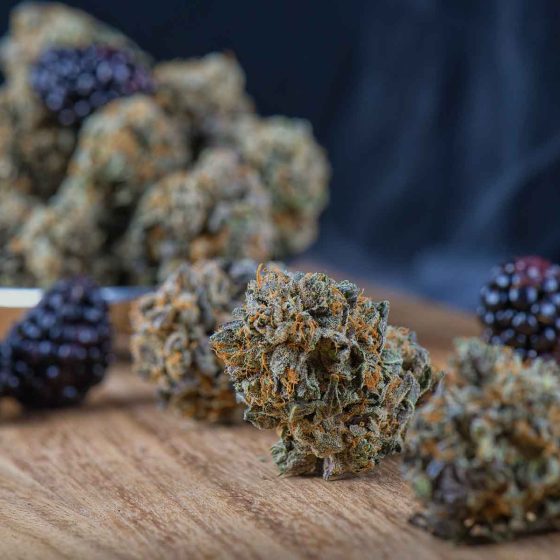
CBD flower is legal and available here – sold over-the-counter at the headshop alongside CBD prerolls, tinctures, and edibles. But much of it’s imported, mostly brought in legally by Icelanders arriving home from abroad, which continues to cause a kerfuffle when customs officials and police get involved. Odinn recalls an occasion when he and his business partner were arrested for declaring their CBD flower to the authorities at Keflavik airport. Although fully aware this would happen, they saw themselves as (bravely) taking a stand in the face of a lack of official awareness.
The greater good
While law enforcement may be slower to catch on, despite the great and good of the international cannabis industry’s presence at the Hemp For Future, it’s clear that there’s a lot of knowledge here already. A man with a long plaited beard and electric eyes, referring to himself as ‘Ganj-alf’, tells me about his own grow some 5 hours east, in a small town of about 400 people. Here, nobody bothers him, and he can experiment with cultivation uninterrupted, creating CBD and CBN-rich flowers that help with all manner of ailments.
Yup, Iceland’s cannabis kings and queens aren’t just about THC. A broader array of cannabinoids, flavonoids, and terpene profiles all feature in the Icelandic cultivator’s repertoire. But cultivation is just one aspect of the cannabis equation, as the conference program demonstrated. Other topics ranged from understanding the Endocannabinoid System in humans and animals, to running a dispensary, via plant mould management, medical cannabis patient care, and how information can power progress.
The conference’s emcee, Steinunn Olina, was also very open about her own experience with cannabis. A well-known actor, presenter, and former presidential candidate in Iceland, she also has a deep connection to the plant. Her late husband, Stefán Karl Stefánsson, benefitted from cannabis during his cancer treatment. Stefán, who was well-known in Iceland and internationally as an actor for his role as antagonist Robbie Rotten in the renowned kids’ TV series LazyTown, sadly passed away in 2016.
However, as Steinunn explains, while she saw firsthand how beneficial cannabis was for her husband in the later stages of his illness, she herself hadn’t consumed it regularly until about a year ago. But she certainly feels the positive impact on her overall health as a woman – a sentiment that was shared by those attending the Cannabis & Women’s Health Workshop the day before the conference proper. Cannabis Queen Melanie Wentzel – Source: Melanie Wentzel
Healthcare professional and author of Cannabis Queens, Melanie Wentzel, had travelled all the way from Australia to deliver this workshop – alongside award-winning podcaster and long-time cannabis advocate, Sara Payan; and Magnus Thorsson, PhD – a native Icelander and professor at Johnson & Wales University in the US, responsible for creating America’s first cannabis entrepreneurship college program.
Combined, their approach was to connect with the workshop attendees, to share their personal stories and to hear from others – creating a safe space for canna-curious women (and men) to learn more about plant medicine and how it’s being used around the world to make a positive difference to people’s lives; from a medical and therapeutic perspective.
Lighting the way
Outside the illicit and the CBD markets, the business of cannabis itself has yet to materialise, which it will when Iceland’s government kickstarts regulation. While that may be a little while off – and despite a Ministry of Health official failing to attend the conference, as promised – Tota and her cannabis crew will continue their endeavours.
As respected cannabis business leader, Jamie Pearson, remarked in her conference opening keynote, there’s a difference between what’s legal and what’s ethical. The two don’t have to be mutually exclusive, but in places where they are, the passion and dedication of those championing plant medicine can’t go unnoticed forever.
As a small, youthful nation that’s been independent for just over 80 years, as I see it, Iceland could steal a march on the rest of Europe. There’s access to power here – unlike in larger nations like the US or the UK. Plus, there’s a female-led government right now, so the issues pertaining to women’s health could well be seen as a determining factor, with the right level of attention.
Icelanders are a hardy bunch, with many working different jobs seasonally to support their families. They’re also excellent at collaboration, particularly when a cause takes root. However long it takes for cannabis prohibition to be repealed, you can be sure that when it does, the efforts of those involved won’t be hidden per se; they’ll remain a source of pride in overcoming the combined hurdles of legislation and stigma; matched with a strong commitment to ensuring that what happens next remains both legal and ethical, for the benefit of all who need access.
Elves included, for those who believe. Is it an elf or is it a lobster? – Source: Dave Barton